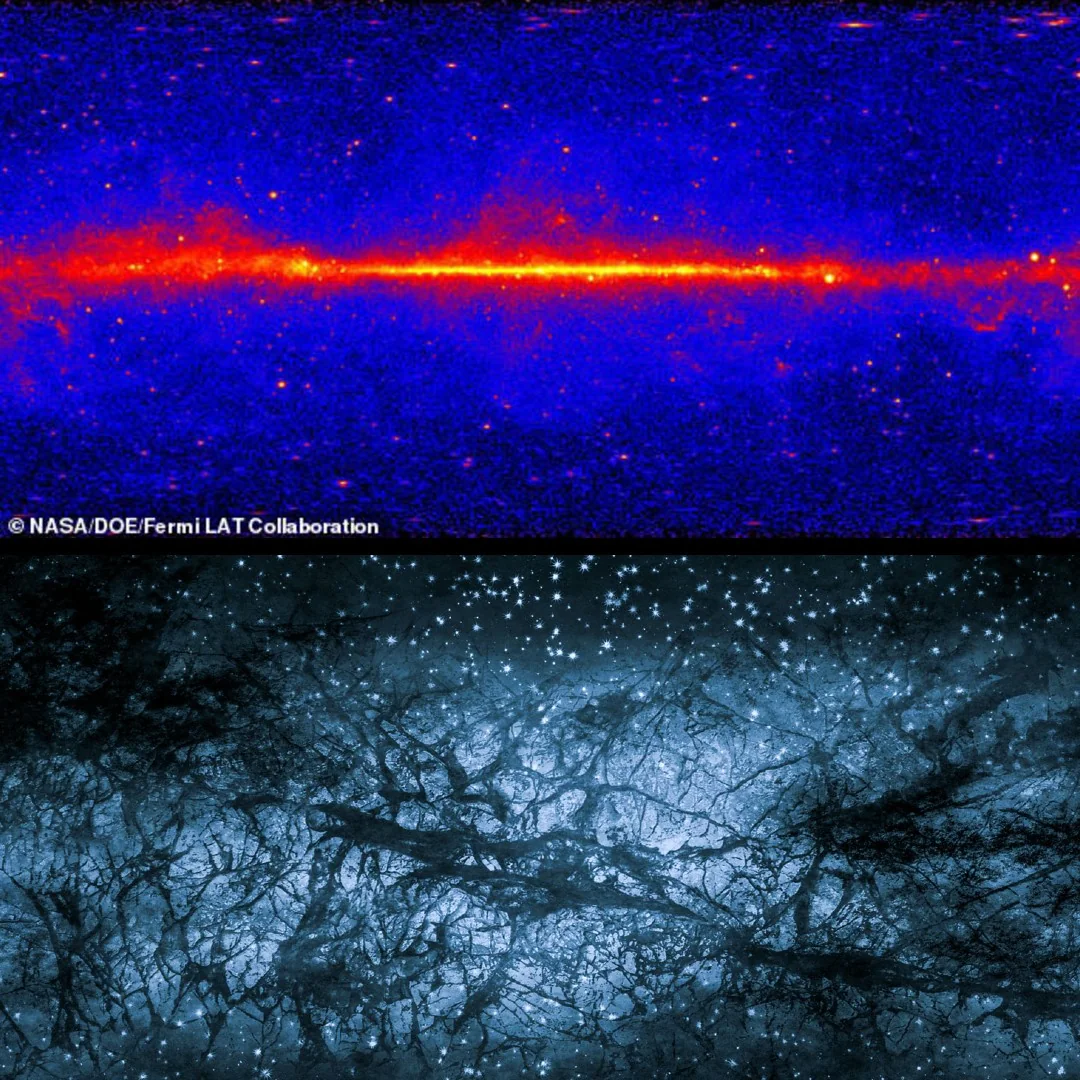
Although dark matter makes up more than a quarter of the universe, it has remained undetectable for decades. Now, researchers at Johns Hopkins University believe they've finally found the evidence scientists have been searching for.
Dark matter itself doesn't emit any energy, but it's thought to give off gamma radiation when its particles collide. That's why scientists believe the mysterious gamma-ray glow at the center of our galaxy could finally reveal where dark matter is hiding. If this hypothesis proves true, it would be the first tangible evidence of dark matter's existence.
Professor Joseph Silk, who participated in the study, explained, "Dark matter dominates the universe and is what holds galaxies together. It's incredibly important, and we're constantly looking for ways to detect it. Gamma rays—and in particular, the extra light we see at the center of our galaxy—may be the first real clue."
What is dark matter?
Dark matter is a mysterious type of particle that makes up most of the so-called 'missing' mass in galaxies. While scientists can observe its gravitational effects, it neither emits nor absorbs light, making it nearly impossible to detect with traditional telescopes.
Since 2008, NASA's Fermi satellite has been mapping the Milky Way using gamma rays. When scientists analyzed the data, they noticed a mysterious, diffuse gamma-ray glow at the center of the galaxy that didn't seem to come from any specific source.
To explain this, scientists proposed two main theories:
FirstThis glow is produced by the spinning cores of dying stars (neutron stars).
SecondIt's the result of collisions between dark matter particles.
Distinguishing between these two theories, however, has proven extremely difficult.
Mapping dark matter
In a study published in Physical Review Letters, researchers used supercomputers to simulate the distribution of dark matter in the galaxy, taking into account how the Milky Way itself formed.
Professor Silk explained, "Our galaxy was formed from a massive cloud of dark matter. As ordinary matter cooled and sank toward the center, it dragged some dark matter with it along the way."
Over billions of years, this led to a build-up of dark matter in the dense galactic core, increasing the likelihood of particle collisions. When scientists compared their simulation with real images from the Fermi telescope, they found a striking match.
While these findings don't amount to "conclusive proof" of dark matter, they strongly support the idea that the gamma-ray glow is indeed a signature of dark matter.
Professor Silk told the Daily Mail, "Our main new finding is that the dark matter model explains the gamma-ray data just as well as the competing neutron star model. The chances that we've indirectly detected dark matter have increased."
Next steps
It's still possible that the gamma rays come from rapidly spinning neutron stars, but the greatest hope lies with the Cherenkov Observatory (Cerenkov Telescope Array), currently under construction in Chile. Once completed, it will be the world's most powerful gamma-ray telescope.
This telescope will be sensitive enough to distinguish subtle differences between gamma rays produced by dark matter and those emitted by neutron stars. It could also be used to survey nearby dwarf galaxies, which are believed to be mostly composed of dark matter.
Professor Silk concluded by saying:
"If we detect the same signal observed by Fermi at the center of our galaxy, it would be the ultimate confirmation of the dark matter hypothesis."
About the Author



No comments:
Post a Comment