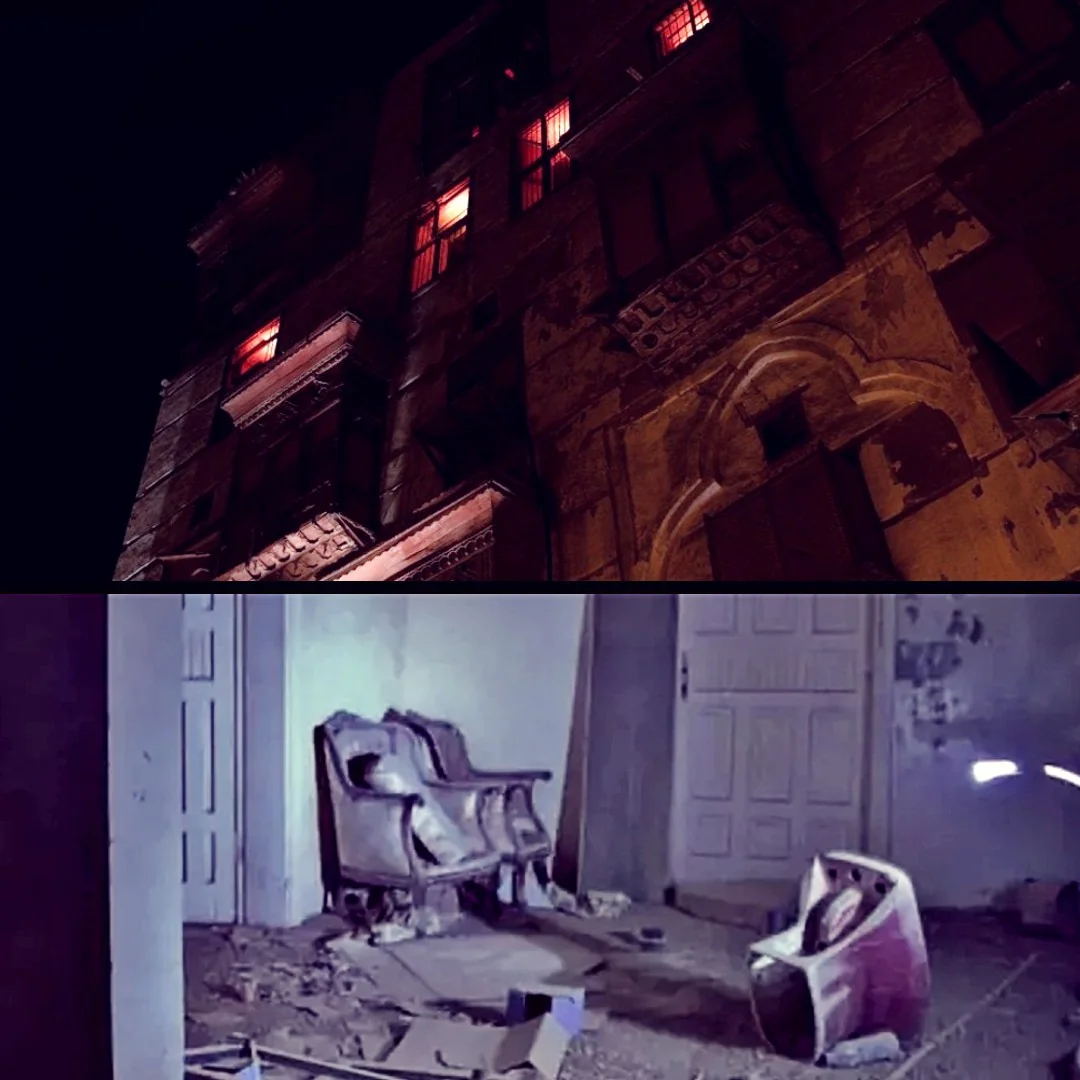
On the northern Corniche of Jeddah, about a hundred meters from the sea, stands an abandoned house that has evolved over time into an icon of fear and urban legend. Locals and expats alike know it as Jeddah’s haunted house, surrounded by stories of 16 people who entered and never came out. Decades later, the house still attracts thrill-seeking teenagers and curious adventurers, becoming a striking example of how legends embed themselves in collective memory..
A majestic architectural relic turned to ruins
The house was once an architectural gem with a distinct Italian style—façades covered with tile and stucco, spacious windows protected by decorative ironwork set with blue and white glass. Ornate iron railings bordered the front garden, and the marble pathways hinted at former grandeur. Over time, however, neglect took its toll: walls are now cracked, ceilings bear black scorch marks from past fires, and the windows have become hollow voids, like 'blind eyes.'
Inside, remnants of the past remain: schoolbooks from the 1980s, scorched old magazines, and rusted children's toys. Even crows have claimed the collapsing roof as their home, adding to the house’s eerie presence as they circle overhead.
The legend: 16 entered, none returned
The most famous tale linked to the house is that 16 people went inside and were never seen again. This story became widely known among locals and was even reported in outlets like Arab News Arab News in 2004. Yet despite its prevalence, there are no official records or police reports confirming any disappearances, making it likely that this legend was born of collective imagination and a fear of the unknown.
Field experience
To test the rumors, a team of journalists spent an entire night inside. Some rooms were in total darkness, with soot-stained walls amplifying the feeling of gloom. The team heard sounds—whispers of wind, the shuffle of gravel, movements of rodents—that their minds interpreted as mysterious 'whispers.' Temperatures seemed to drop inexplicably in the flooded basement. Their conclusion: there were no ghosts or supernatural beings, only an atmosphere that fueled human fear and imagination.
A supernatural magnet
The house earned another nickname: 'magnet for youth.' It draws in adventurous teenagers and Corniche regulars, who drive up at 3 a.m., daring one another to go inside. The adventure usually ends in a panicked rush to leave or in simply standing at the gate, unable to cross the threshold. It’s not so much about jinn as it is about collective fear, where bravado quickly dissolves when faced with the unknown. Read more at Ghost-hunting or chasing legend?
The 'haunted houses' wave (2012)
Obsession with abandoned buildings hasn’t been limited to this house. In 2012, Saudi Arabia saw a trend dubbed the 'National Day of Entering Jinn Houses.' Hundreds of young people stormed the abandoned Erqa Hospital in Riyadh and similar sites in other cities, resulting in fires and major damage. The phenomenon showed how legends can spark collective actions that go beyond curiosity, creating real danger to lives and property.
Why has the story endured?
The beauty of decay: Every visual element—shadows, ruins, crows—triggers primal fear.
Psychological suggestion: Anyone who’s heard the legend interprets any sound or movement as proof of the supernatural.
Story contagion: Repetition across generations has embedded the tale into popular memory as fact.
Years without official information: Allowed rumors and myths to fill the gap.
Jeddah’s haunted house remains a living legend, shaped by many factors: a deteriorating structure, signs of vandalism and fire, fertile popular imagination, and the daring exploits of young adventurers. While there’s no concrete evidence of any ghosts within, the place has mirrored society’s collective anxieties and appetite for adventure. It’s a story about the birth of the supernatural from reality: a ruined building becoming a symbol, an ordinary house turned into an icon of fear.
In truth, the house is nothing more than an 'old lady,' as one journalist put it—worn down but still exuding a certain dignity, even as new tales keep appearing around her.
About the Author



No comments:
Post a Comment