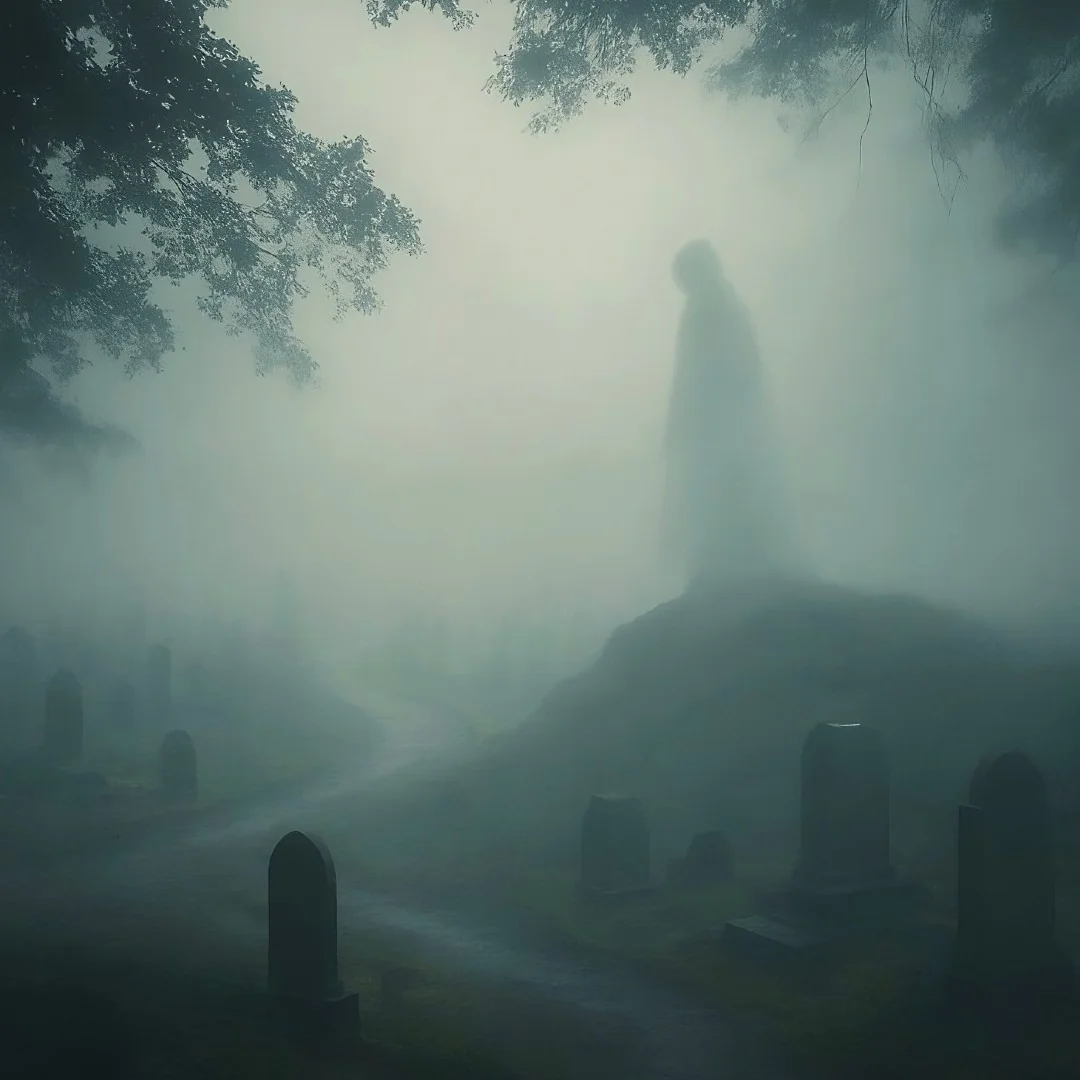
Since the dawn of history, fog has held a deep association with the mysterious and the unknown. When the world turns grey, it feels as though nature herself is crossing into another realm.
In those moments when moisture thickens and the line between seen and unseen dissolves, we experience something beyond mere sight: visions that flicker between illusion and reality, fear and fascination.
Fog: A Veil Between Worlds
When mist settles over fields, graveyards, or the edge of forests, the landscape transforms into a mystical space. It's no coincidence that ancient legends called this hour 'the time of spirits.' The Celts, Greeks, and Romans believed souls walked the earth whenever air met water at dawn’s chill.
During medieval Europe, monks wrote of seeing 'luminous specters' over monasteries following storms, often shrouded in thick fog—interpreted as divine signs. Some church chronicles even told of ghostly knightly processions crossing valleys, a phenomenon now likely explained by the atmospheric effect known as the 'Brocken Spectre': a giant shadow cast upon the mist by sunlight from behind, appearing as a towering ethereal figure.
Personal Encounters
Even in the modern era, fog inspires its own legends. Visitors to Gettysburg in the US, the woods of Edale in England, or Japan’s Mount Fuji tell stories of human shapes drifting and dissolving in the mist, of whispers with no source, and footsteps echoing with no visible owner.
These ambiguous sensory experiences often happen in conditions of low visibility and quiet, when the mind becomes hyper-attuned to the slightest visual or auditory cue, building entire images from something barely there.
One 19th-century British lighthouse keeper wrote in his journal about a 'man who appeared each foggy morning, only to vanish before the waves touched his feet'—a vision later explained as a recurring shadow illusion sparked by layers of moisture.
The Mind and the Mist
Psychologically, fog is sometimes compared to 'white noise' for the eyes. Just as constant sound fills auditory space, fog fills our field of vision. When images lose definition, the brain starts to 'guess' what might be there—a process called perceptual filling-in.
At that point, seeing becomes an open field for our mind’s projections: memories, hidden fears, or familiar faces. In the fog, you might perceive someone you know, a historical figure, or a being with no known origin.
Psychologists refer to this as visual pareidolia—the brain’s tendency to find meaningful patterns in vague shapes. In essence, the mind creates its own ghosts from the fabric of nature.
Sensory Deprivation and the Imagination
When light and sound are muffled—during a foggy night or deep inside smoke-filled tunnels—people can experience what's known as sensory deprivation, a state where the brain fills in sensory gaps with inner imagery.
Soldiers in both World Wars reported seeing 'processions of fallen comrades' during thick fogs. Neuroscientists observe that this lack of external stimuli activates parts of the brain that generate vivid mental images, sometimes resulting in hallucinations that feel utterly real.
The Ghosts of Gettysburg
They say Gettysburg never healed from its terrible battle, and that the spirits of those who fell still wander its fog-soaked fields. On damp nights, when mist settles over the rolling hills and old farms, some visitors glimpse uncanny sights: silent regiments drifting by, figures in blue caps slipping between the trees, and the sound of hooves piercing the clouds with no horse in sight. Smoky powder from old gunfire mingles with new mist, turning the fields into a broken reel of time where phantoms seem suspended, as if their final moments never truly ended.
Researchers who study the paranormal believe Gettysburg’s fog is more than just weather—it acts as an energy medium that reshapes the battlefield’s embedded memories. Psychologists, meanwhile, see mist as a simple visual barrier, blurring what’s real and what’s imagined, allowing weary eyes and vivid imaginations to conjure the soldiers who never left the field.
Where Fog Meets Smoke, Dust, and Storms
Fog isn’t the only thing that blurs the line between reality and illusion. Smoke from fires or battles creates similar effects: heat, suspended particles, shifting light—causing forms to dance like specters.
Thick desert dust can create mirages as striking as apparitions, as early explorers described seeing 'spirits walking the horizon.' Even blowing snow or sandstorms have the same ability to dull the senses and awaken the imagination.
Fog as Inspiration in Horror Literature
Of all nature’s elements to inspire horror writers, few match fog’s power to unsettle and suggest the unknown. It’s more than just a backdrop; in their stories, fog becomes a character in its own right—a shapeshifting presence that hides what shouldn’t be seen.
From the early 19th century, authors realized fog was the perfect veil between the world of the living and a shadowy beyond. Writers like Edgar Allan Poe and Bram Stoker (the author of Dracula), followed by Stephen King, who mastered the art of building tension, making readers feel as if something dreadful is lurking just out of sight, ready to emerge from behind the gray curtain.
In the novel Dracula the mist crept in as an extension of the vampire’s will, while in Stephen King’s The Mist, the mist itself became a living entity, a shroud concealing monsters from another realm. Over time, mist has come to symbolize the unknowable—a fertile ground for supernatural imagination, reflecting our fascination with mystery and fear of the unknown. The denser the mist, the wider the doorway to the nightmares that fill our literature and dreams.
Between science and legend
Despite the straightforward scientific explanation, there’s no denying the unique allure of fog. It’s a rare blend of light, water, and stillness that leaves us feeling suspended between two worlds.
Across cultures—from the Chinese, who believed spirits traveled within the fog, to ancient Arabs, who called it 'the breath of jinn'—this mysterious phenomenon has symbolized revelation and the threshold between the visible and the unseen.
Fog is more than a weather event; it’s a reflection of our imagination. It reminds us how our minds can see what they wish, and how mystery, when it conceals the world, also opens new doors to understanding.
While scientists are determined to explain every shadow with light and humidity, humanity has always sensed something more in the mist—a spirit waiting quietly, longing to be seen.
About the Author



No comments:
Post a Comment