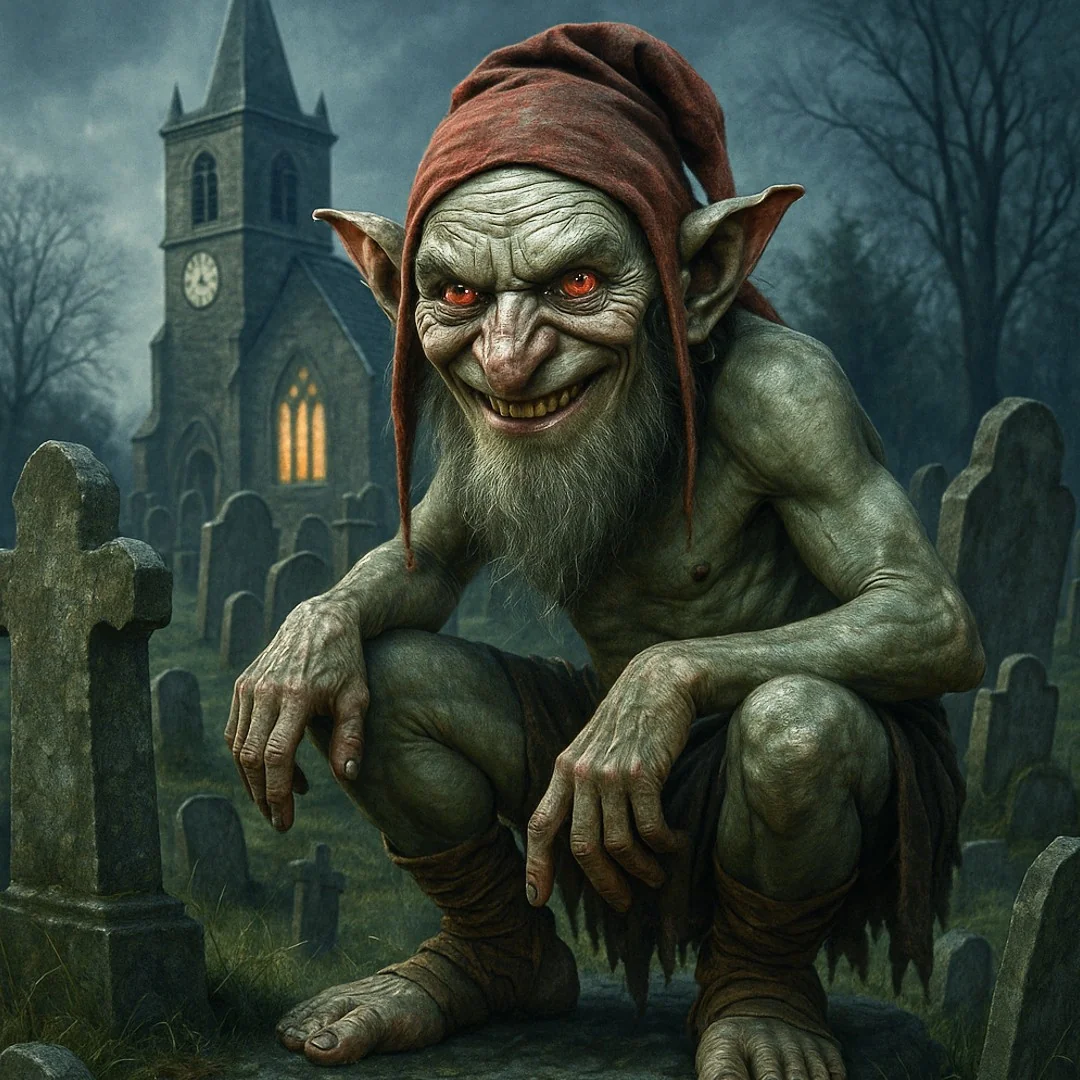
Deep within British folklore, stories abound of a mysterious creature—neither wholly benevolent nor purely evil. It lurks in the shadows of old graveyards and stone churches, playing tricks on passersby, changing the church clock’s time, whispering in visitors’ ears, and hiding their belongings only to return them later. This is the Hobgoblin Hobgoblin—the mischievous goblin that has thrived in the realm of myth for centuries.
Origins and Etymology
The word Hobgoblin Hobgoblin dates back to Middle English, and is made up of two parts:
Hob Hob is a familiar nickname, derived from Robin “Robin” or Robert “Robert”, and was often used to refer to a friendly household spirit. Goblin Goblin comes from old Germanic languages, meaning “goblin" or “evil spirit.”
So, the Hobgoblin "Hobgoblin" blends opposites: kindness and cunning, a being caught between good and evil—much as people often balance faith and doubt. In Germanic folklore, it’s close to the German kobold and Scottish brownie—helpful house spirits that could turn nasty if ignored or insulted.
The Hobgoblin in English Folklore
In the English countryside, people believed this creature lived in basement cellars or near the hearth. It would help the master of the house at harvest and bring good luck to the livestock—provided it received a symbolic offering of milk or cake.
But if neglected or mocked, it could become angry: scattering tools, making noises at night, tangling horses’ manes, or tossing ashes on the floor—behavior ancient people saw as sure signs of a spirit’s wrath.
During the Middle Ages, the clergy painted the hobgoblin with a hint of the demonic, since something that stands between good and evil clashed with the church’s binary worldview. Gradually, it came to be seen as a cursed spirit haunting graveyards and churches, mocking the faithful.
The Old Graveyard Legend
In a remote northern English village, locals tell of a goblin haunting the old graveyard by the seventeenth-century stone church. It supposedly changes the time on the church tower’s great clock during the night, confusing villagers who rely on it to mark the hours for prayer.
It also loves hiding visitors’ belongings—keys, coins, or wedding rings—which then turn up in the strangest places days later.
On some nights, cold whispers are felt close to the ear or a warm breath on the neck, as if someone stands behind you… but nothing can be seen but the silent gravestones’ shadows.
Some witnesses claim to have felt invisible fingers gently push or tap them with mocking affection, while others recall muffled laughter echoing among the tombs, as if coming from the earth itself.
The Hobgoblin in Literature
The hobgoblin found its way into English literature early on. William Shakespeare famously cast it in A Midsummer Night’s Dream, embodied by the playful sprite Puck Puck, who meddles in human affairs with a mix of charm and mischief.
Later, especially in Victorian fiction, this goblin Hobgoblin became a symbol of haunted places and rural weirdness—before evolving in modern fantasy as a figure equal parts whimsy and menace.
Psychological and Symbolic Depth
Symbolically, the hobgoblin represents the hidden side of the human mind—the mysterious energy that toys with us, testing the balance between order and chaos.
It’s an expression of the “collective unconscious,” a term introduced by Carl Jung, where psychic forces manifest as mythical entities that reflect our deepest fears and buried guilt.
The graveyard said to be its home is itself a symbol: the threshold between life and death, matter and spirit. It’s only natural, then, for the hobgoblin Hobgoblin to appear here, embodying our existential anxiety about death and its eternal silence.
Fact and Folklore
While science has never substantiated the existence of such beings, the tales have persisted. They are echoes of ancient fears that linger even in our technological age.
Every unexplained sound in an abandoned graveyard, every shadow flitting across the wall of an old church, brings to mind the idea that spirits may still be among us—disguised as a mischievous goblin laughing in the dark.
In the end, this goblin stands as one of the most mysterious and enchanting figures in European folklore—a blend of kindness and cunning, fear and curiosity. Whether real or imagined isn’t what matters; what’s important is how it reminds us that folklore reflects the deepest corners of the human soul, revealing what we both dread and desire. The hobgoblin lives on the world’s edges—in a fog-laden cemetery, forever waiting for someone to play its eternal game of mischief and mystery.
About the Author



No comments:
Post a Comment