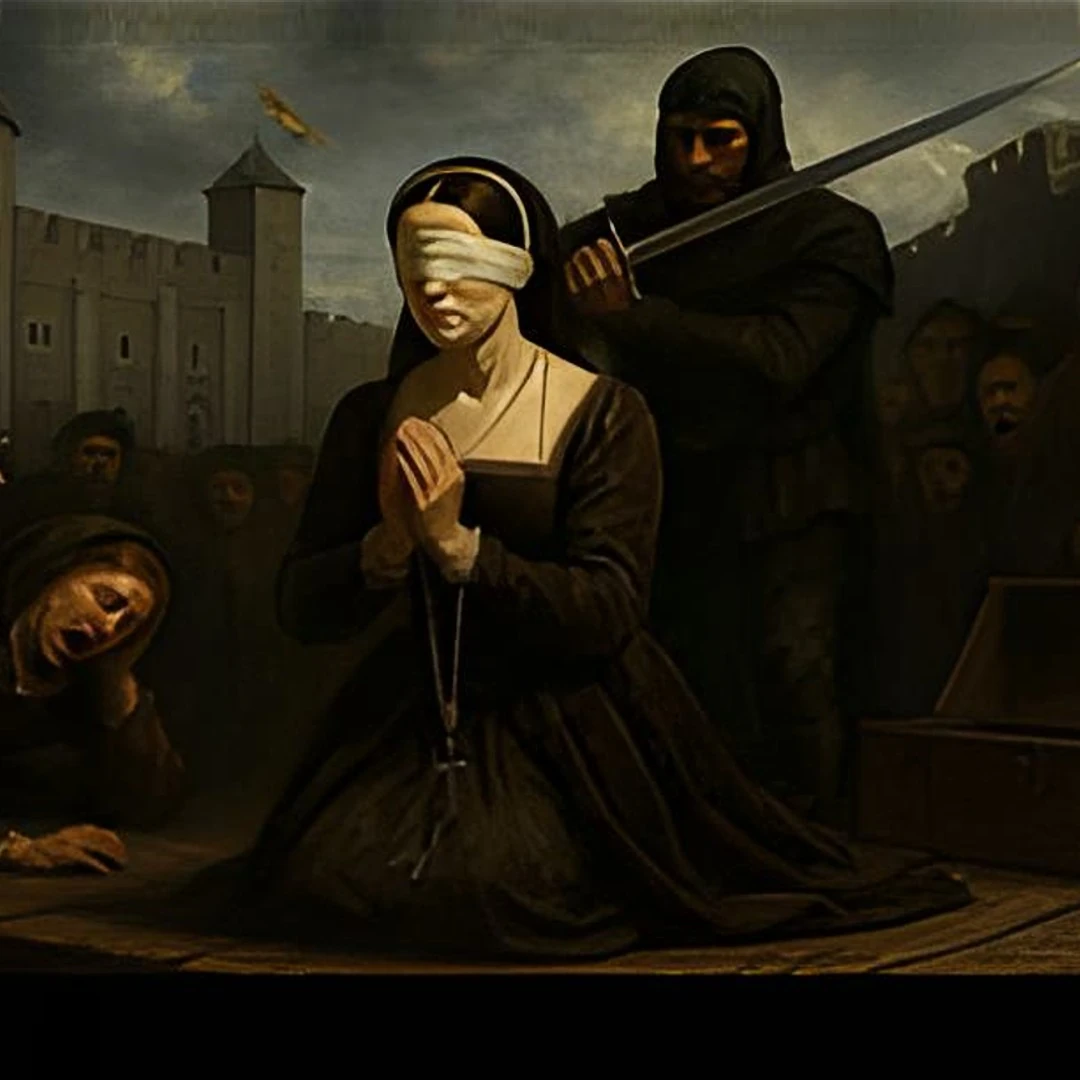
In the spring of 1536, crowds gathered at the Tower of London to witness one of England’s most chilling historical events: the execution of Queen Anne Boleyn.
Anne Boleyn, the second wife of King Henry VIII, was the woman whose presence forever altered Europe’s religious and political landscape. But what made her execution even more haunting was this: witnesses claimed Anne’s lips were still moving seconds after she was beheaded—a mystery that’s captivated historians and fueled the public imagination for centuries.
This article revisits Anne Boleyn’s tragic fall from power, exploring both scientific explanations and legendary accounts of her final moments—along with the ghost story that claims she haunts the Tower’s dark passageways to this day.
Who was Anne Boleyn?
Born around 1501 to a noble family, Anne Boleyn was raised at the royal courts of France and the Netherlands, where she gained a refined education and striking allure—qualities that soon caught the eye of King Henry VIII. Brilliant, accomplished in music and literature, and known for her commanding presence, Anne became the object of Henry's affection even though he was married to Queen Catherine of Aragon.
The Woman Who Sparked a Religious Revolution
Anne refused to be just another royal mistress. Insisting on marriage, she drove Henry to break from the Catholic Church and establish the Church of England—triggering one of the greatest religious shifts in European history.
In 1533, Anne became Queen of England and gave birth to Princess Elizabeth, the future Elizabeth I. But her path to the throne made her many enemies, and her downfall proved swifter than her rise.
Conspiracy and Deadly Accusations
By 1536, Henry had lost interest in Anne, and her inability to produce a male heir brought her position to the brink. Political scheming and rumors took over: Anne was accused—likely unjustly—of treason, adultery, incest with her brother George Boleyn, and plotting to murder the king. Her trial was a formality; the sentence was death by sword, considered “kinder” than the axe.Anne Boleyn’s Last Words
On May 19, 1536, Anne Boleyn climbed the scaffold at the Tower of London. Calm and dignified in a dark gown, she delivered her final words aloud for all to hear.
She knelt, gazed upward, and spoke words faithfully recorded by observers like Chapuys, Edward Hall, and John Foxe—statements that remain among the most famous in English history:
"Gentlemen, I have come here to die, not to accuse anyone.
I ask you to remain loyal to King Henry, for he is the best and noblest of princes.
He has always been a good and gentle ruler…
If ever I have failed him in anything, I humbly ask God’s forgiveness.
And I pray for God to protect His Majesty and grant him a long life.
I also pray for England, and for those who shall govern it after him.
And I beg God to have mercy on me.
Into His hands I commend my soul."
Afterward, she comforted her lady-in-waiting: “Do not weep, for God has given me peace of heart.” Then she knelt.
She began whispering her final prayers: “Jesus, have mercy… Lord, receive my soul.” These were her last words before the executioner performed his famous deception, asking, “Where is my sword?” causing Anne to glance aside—her life ending with a single blow.
The Execution
Just before the blow, Anne knelt on the platform and raised her head as instructed. Standing quietly behind her, the executioner gave a sign for a distraction and then called out loudly: “ ? Where is my sword” meaning “Where is my sword?” The ruse made Anne believe he hadn’t yet readied the blade. She instinctively turned her eyes in the direction of the voice, and at that instant the executioner delivered a swift, clean strike.
This was a practiced tactic among French executioners to spare the condemned unnecessary fear; approaching directly with the sword might make a person flinch, risking an incomplete blow. In other words, it was a humane trick to ensure a single, merciful ending.
The Lip Movements That Terrified Witnesses
When the sharp French sword struck and Anne was beheaded in a single stroke, something unforgettable occurred—her lips continued to move after death. Eyewitnesses reported that her mouth worked for several seconds as the executioner lifted her head; some thought she seemed to be mouthing words or finishing a prayer started moments earlier.
Was Anne truly conscious? Or were these involuntary muscle spasms? What does science say?
Modern research suggests:
- The brain may remain conscious for 4 to 30 seconds after decapitation in some mammals.
- The head, unlike the rest of the body, doesn’t suffer direct trauma and the brain can function briefly before blood flow is lost.
- Facial muscles (lips, eyelids) may twitch involuntarily due to residual electrical activity.
- This explains why some people blink or their lips move after execution by sword.
Still, the idea that Anne may have witnessed the first moments of her own death remains chilling even today.
Her Ghostly Apparitions
Anne Boleyn is Britain’s most famous ghost, with dozens of witnesses—from the 17th century to the present—claiming to have seen her at:
1- The Tower of London
She’s sometimes seen as a regal woman in royal dress, carrying her head, or walking headless.
Guards report hearing her footsteps in the White Tower at night.
2- Hever Castle (her family home)
Her most peaceful haunting; she appears by the castle river on the anniversary of her execution, as if searching for the peace she never found in life.
3- Sandringham House
A figure resembling her is said to run through the old corridors, especially on misty nights.
4- Blickling Church
Some legends claim her head was brought here after the execution, and a headless ghost has reportedly appeared on the church grounds.
Anne Boleyn: Between Fact and Legend
Anne Boleyn remains a symbol of change, and the circumstances of her death have sparked debate for five centuries. She made history in life—and forged legend in death: a woman who faced her fate with courage, whose head was severed with a single stroke, and, as the story goes, didn’t stop speaking. Some even whisper her lips still move—whether in this world or the next.
About the Author



No comments:
Post a Comment