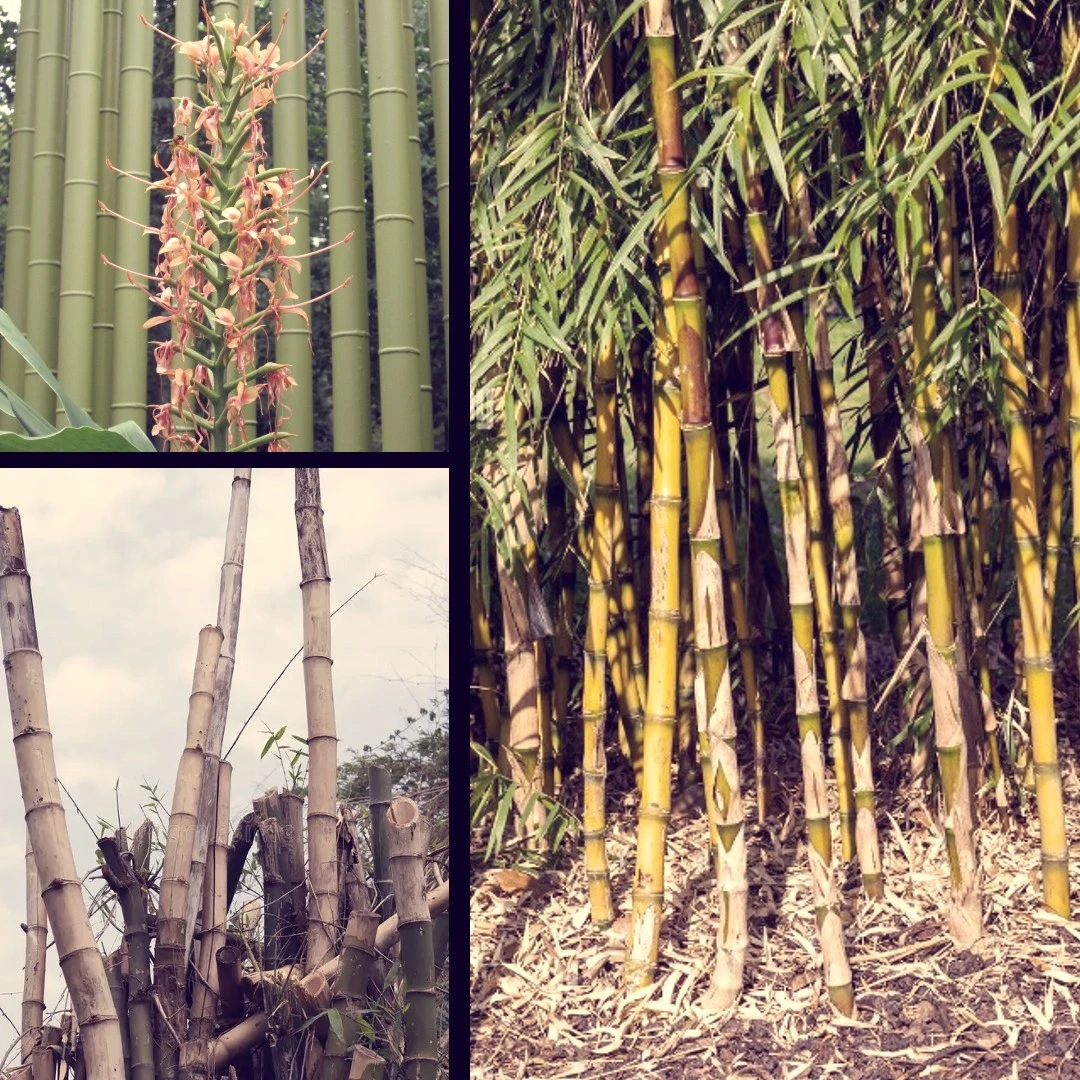
Nature is full of secrets—some small ones we encounter in daily life, and others so immense they play out across the entire planet, as if nature itself moves to a rhythm beyond human perception. One such phenomenon is the synchronization of hormonal cycles among women living together, a much-debated topic in behavioral biology. But there’s an even more remarkable natural phenomenon, largely unknown, that is far stranger and more awe-inspiring. This is the story of bamboo: the calm, unassuming plant that suddenly transforms into a cosmic force, receiving a hidden signal to bloom and die—in perfect unison with millions of its kin all over the world.
What is "mass flowering"?
Mass flowering is a rare botanical event involving certain bamboo species, where every individual of the same species—no matter their location—blooms at the same time, and then dies. We're not just talking about bamboo in one valley or forest; they could be in China, India, California, the Himalayas, or home gardens across Europe.
Yet, they all flower in the same year, the same month—and sometimes even the same week!
Strangest of all?
This only happens once every 60 to 130 years depending on the species, and the plants remain dormant their entire lives, waiting for the internal clock to strike.
The Internal Clock: A Mystifying Mechanism
Every bamboo plant carries a genetic program—a built-in timer unaffected by weather, light, seasons, or soil. When the species' allotted lifespan is up—a set age for all plants from the same lineage—a hidden biological signal triggers: it's time. Bloom together, now.
No one knows what molecule flips this biological switch, or how the timer stays accurate through countless generations of splits and growth.
Why aren’t the timing and bloom thrown off by different climates, atmospheres, or soils?
All we know is that every bamboo descended from a single parent—whether in an Asian forest or an American backyard—acts as though it’s still part of the same original plant.
It's like a global biological family—a genetic network breathing as one.
Mass Suicide
After flowering, the bamboo uses up all its energy producing an enormous crop of seeds. Then it dies.
But why would nature choose such a fate?
There are three main theories:
1- Predator Satiation Hypothesis
When millions of bamboo plants produce seeds all at once, animals can't possibly eat them all—ensuring enough seeds survive to start a new generation.
2- Habitat Liberation Hypothesis
Mass death of bamboo leaves large open spaces, ready to be claimed by the next generation of seeds.
3- Rigid Genetic Clock Hypothesis
Each plant has the same 'countdown timer,' and when time’s up, it obeys without exception.
No matter which theory is right, the precise timing of this organized mass death remains an enduring scientific mystery.
A Genetic Network Across Continents
The reason for this global synchrony is that most bamboo grown worldwide are clones—genetically identical offshoots of the same original plant. In other words: bamboo in Japan, California, or South America could all be one and the same genetic entity.
They aren’t “different individuals,” but rather a single living body stretched across geography. That’s why when bamboo blooms in the East, its sibling blooms in the West.
An Unusual Comparison: Women and Bamboo
The phenomenon of synchronized menstrual cycles among women—debated though it is—is a familiar example of how living creatures can “sync up” when sharing space and time. But bamboo elevates the idea to legendary proportions:
- Women synchronize through hormonal and behavioral cues.
- Bamboo, on the other hand, is tuned by an unchanging genetic code, immune to outside influences.
It isn’t simply harmony—it’s a biological fate set in stone from the moment the original plant split its first cell.
If women operated on a bamboo-like cycle—flowering once every 80 years—humanity’s numbers would be halved, and entire civilizations might revolve around fertility cycles to rival eclipses!
Prophecies, Famines, and Legends
In India and Bangladesh, bamboo flowering has long been associated with famine, plagues of rats, and collapsing crops. Rats gorge on the bamboo seeds and their populations explode, sweeping through villages. Local people often saw these events as ominous signs from the universe, believing nature was preparing for some great upheaval.
In Japan and China, mass bamboo flowering was historically seen as an omen of a dynasty's downfall—much like how natural disasters in legends mark the turning of eras.
Is this an inner language... or a form of plant consciousness?
Scientists are grappling with a fundamental question: is synchronized flowering just genetic programming, or could it be a form of communication between plants at a level we don't yet understand?
Bamboo doesn’t use typical pheromones, nor does it rely on light or seasonal cues. It obeys a signal we haven’t yet identified.
Here, science steps into a gray area that borders on the metaphysical:
- Could plants share a universal 'clock' of awareness?
- Do they have a genetic memory that transcends geographic boundaries?
- Is nature more intelligent than we think?
When nature behaves as a single organism
The mass flowering of bamboo isn’t just a biological event—it's a cosmic puzzle that suggests living things, however simple they appear, might be part of hidden systems far more complex than we imagine.
If women can synchronize their cycles under one roof, bamboo synchronizes under an entire sky.
This phenomenon isn’t just about plants; it’s a lesson in the unity of life, the mysteries of nature, genetic brilliance, and the secret cosmic timing that’s been at work in silence for millions of years.
About the Author



No comments:
Post a Comment